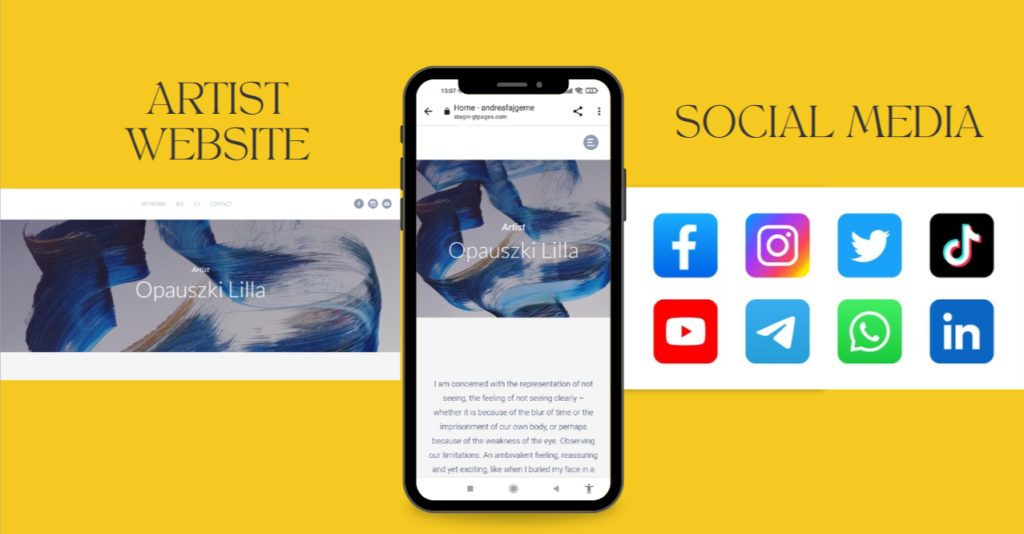
Today, both a website and social media are indispensable tools for any artist. While each can be effective on its own, they are truly powerful when used together. Let’s take a look at how they complement each other and why both are important for you.
What a website is for
A website provides a comprehensive overview of you and your art. It includes your resume and biography, and makes your works searchable. It organizes past news, events, professional publications, etc., into an archive by year, theme, or series. With this content, your website becomes a truly stable and permanent cornerstone of your online presence. Since you control when, what, and how content appears on it, you have complete control over it. You will be the one to build the website’s structure and determine the design in which your content is displayed. There are no disruptive or misleading algorithms that can hide your content from visitors. This way, you can convey much more information through your website with far greater precision than on social media platforms. The information gathered on your website can provide context—not just snapshots—of your work and your creative process as a whole.
Your motivations, your career path to date, and professional feedback all become clearer. Moreover, while trends on social media platforms come and go, your website remains a constant and is independent of any platform. You’re free to shape it into a sales tool or a community-building tool.
The Role of Social Media
The purpose of social media is to provide a fast, interactive, and direct way to connect with others. We can connect with almost anyone who is also active on social media platforms (e.g., Instagram, Facebook, TikTok). The goal is to build a rapidly growing and loyal following around yourself. People can give you feedback and spread your work through shares. But it’s not always easy to come up with and post new content. You could, for example, share behind-the-scenes secrets or post information and news related to a piece of art, accompanied by a video or image. However, creating high-quality content takes quite a bit of time. Not to mention the ongoing dialogue with your audience.
How do websites and social media complement each other?
Social media is essentially a tool that drives traffic to your website. For example, by sharing a link to a new blog post, an exhibition, or a piece of artwork on social media platforms, you can direct interested users directly to your website. Or, even more effectively, you can significantly increase website traffic using social media ads.
Why is this important? Because while social media is interactive and fast, it doesn’t always allow for sharing detailed information—not to mention that you don’t always reach the people you really want to.
This is where your website comes in: It allows for a more in-depth introduction, and with a unique design and content, you project a more professional image—something social media can’t always provide.
Meanwhile—and this is perhaps the most important point—the leads generated by campaigns running on your website (in compliance with GDPR regulations) will belong to you, not to social media.
Both should be used appropriately: while social media is the arena for daily activity, a website is a timeless, comprehensive tool for presenting your work. When used together, they become truly effective. On Instagram or TikTok, quick, attention-grabbing content draws attention to your latest work or project. From there, interested visitors can visit your website for more details and provide their email addresses to make future communication smoother and more personal.
Think in terms of a multi-channel strategy. Social media provides an opportunity for immediate engagement and reaching a wider audience, while your website helps retain your audience in the long term. Details of art events advertised on social media can be found on your website, where visitors can, for example, subscribe to your newsletter or even make a purchase.
The combination of a website and social media creates a synergy that fully leverages your ability to connect with your audience, track your professional life, and sell your artwork.